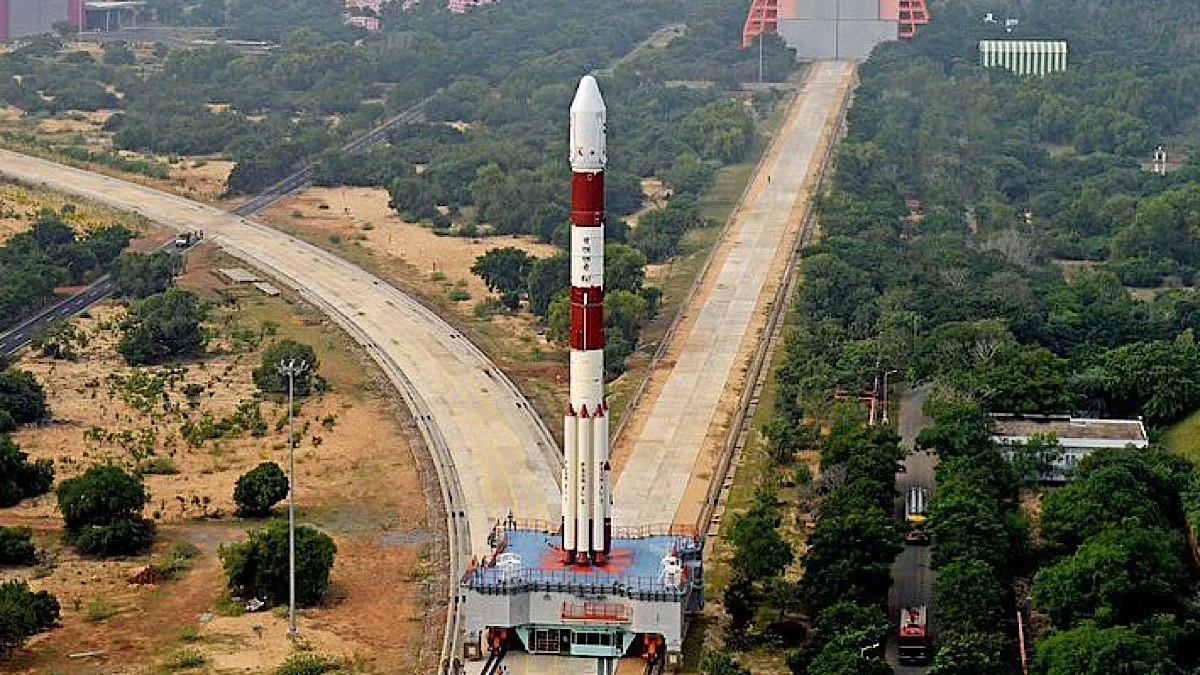
A two-member committee has been formed by the Indian government to probe the recent failure of the rocket Polar Satellite Launch Vehicle (PSLV) that carried the country’s strategic satellite, it is reliably learnt.
The committee comprises K Vijayraghavan, former Principal Scientific Advisor to the Prime Minister, as Chairman, and former Secretary of the Department of Space and former ISRO Chairman Dr. S. Somanath as Co-Chairman.
Advertisement
Interestingly, the formation of the two-member committee comes after the low-key visit of National Security Advisor Ajit Doval to the Vikram Sarabhai Space Centre (VSSC), Thiruvananthapuram in Kerala.
On Jan 12, 2026, Indian Space Research Organisation’s (ISRO) rocket coded PSLV-C62 carrying the strategic hyperspectral satellite Avnesha or EOS-N1 failed midway.
Along with EOS-N1, 15 other satellites belonging to Indian and foreign organisations were lost.
Speaking about the mission, Secretary of the Department of Space and Chairman Dr. V. Narayanan said the rocket experienced disturbances towards the end of the third stage performance, while the first two stages had performed normally.
Subsequently, towards the end of the third stage burn, there was a deviation in the rocket’s flight path, Narayanan said.
As per reports, an internal committee of ISRO has been analysing the flight data.
The PSLV is a four-staged rocket powered by solid and liquid propellants alternatively.
The first and third stages are fired by solid propellant, and the second and fourth stages are fired by liquid propellant.
In a new twist to the PSLV-C62 failure tale, the evidence suggests its fourth stage actually ignited before the vehicle descended back to Earth.
According to Spanish space company Orbital Paradigm, which had launched its space craft Kestrel Initial Technology Demonstrator (KID) aboard the rocket, the fourth stage began thrusting even as the vehicle was already falling.
In its post-flight report titled “The KID Survived,” the company stated that after separating from the third stage, the PSLV initiated fourth-stage thrust while descending.
However, Orbital Paradigm said it has no data regarding the vehicle’s trajectory during this burn, nor precise information about when and where the upper stage, carrying KID, re-entered the atmosphere to around 120 km altitude.
The Jan 12, 2025 rocketing was an action replay of an earlier PSLV-C61 rocket that flew in May 2025.
“The failure of PSLV-C62 seems to be similar to that of its predecessor PSLV-C61,” a rocket expert not wanting to be quoted told this correspondent.
In May 2025, the XL variant of PSLV, designated as PSLV-C61, lifted off with a 1,696.24 kg earth observation satellite or RISAT-1B (radar imaging satellite with synthetic aperture radar).
Around six minutes into its flight, and soon after the solid fuel third stage was ignited, trouble started, and the vehicle veered off the path as was seen on the screen at the Mission Control Centre.
Even then, Narayanan said the first two stages of the rocket performed as expected, and during the third stage performance, there was an ‘observation,’ and the EOS-09 mission could not be accomplished.
He also told the journalists that there was a fall in the third-stage chamber pressure in the motor case.
A former senior official of ISRO said the failure of the third stage could be due to a faulty valve-main and the redundant or some other component that resulted in the fall in the chamber pressure.
The PSLV-C62 rocket failure is the third consecutive failure of a mission that was to serve India’s strategic interests.
In January 2025, the 2,250 kg navigation satellite NVS-02 was placed in the Geosynchronous Transfer Orbit (GTO). The satellite got stuck there as its pyro valve did not open to pump in the oxidiser to fire the motors while the fuel pumps were working.
It is said that one of the probable reasons for the pyro valve of NVS-02 not opening could be a fault with the electrical connector. However, it is still unknown as to the actual reason for the pyro valve’s failure.
The report of the Failure Analysis Committee headed by former ISRO Chairman A.S.Kiran Kumar, set up by ISRO to study the NVS-02 failure, has not been made public to date, again at variance with the space agency’s earlier practice.
The serious issue is the successive failures of India’s satellite missions that were expected to serve the country’s strategic interests.
“Once it is an accident, twice it is a failure, and the third time?! What could it be?” wondered a retired senior official of the Indian space agency.
There is no fixation of accountability and responsibility when missions involving hundreds of crores of Indian taxpayers’ money goes waste, the official added.